ORGANISMIC.

The category

Not quite a book. Not quite software. It earned a name.

Every asset in this catalogue — free or paid, analog or agentic — is the same kind of object: a published work that is also a running instrument. Here is the exact account of what that means, what it's built from, and why its specific form turns out to be where the field's real engineering frontier currently sits.


I. The problem with the obvious names

Call it a book, and something's missing. Call it software, and something else is.

It is sold, so the instinct is to call it a product. It is written at the length of a book, with the apparatus of scholarship, so the instinct is to call it a book. It runs and produces work, so the instinct is to call it software. Each instinct is partly right — which is exactly why none of them is sufficient, and why the thing keeps slipping out of whatever category it's filed under.

The test of whether something earns a new name isn't whether it resembles existing things — resemblance is cheap. The test is whether the existing names, applied honestly, leave something essential unaccounted for. Every name applied to this object leaves a remainder, and the remainders are not trivial. They're the parts that do the actual work. That's the signature of a genuine category, not a rebrand.


II. The name was waiting for the thing

Organon — a word that already meant "a writing that is also a tool"

The word is old and it is exact. In Greek, ὄργανον (órganon) means an instrument — a tool, the thing with which work is done. It is also the title under which Aristotle's works on reasoning were gathered by those who came after him: the Organon, the instrument of thought. So the word already carries, in a single term, the two things this object is at once — a work, an authored body of writing, and an instrument, a tool that performs. An Organon is a writing that is also a tool. That isn't a metaphor reached for after the fact; it's the most exact description available for a book-length work whose purpose is to be run. The word was waiting for the thing.

There's a further precision worth stating plainly, because it's the kind of coincidence that can be made to sound like more than it is. Organon descends from the Greek ἔργον (ergon), meaning work — the same root beneath organ, organism, and the name ORGANISMIC. The firm that builds these objects and the category the objects belong to are, at the root, the same word, and that word is work. This is a real correspondence and a useful one: it makes the whole vocabulary coherent, teachable, easy to hold in mind. It should not be mistaken for evidence of anything beyond itself — the coherence is the result of drawing every term from one consistent ancient source and applying it carefully. A well-built thing resonates with the tradition it was built from. That's craftsmanship, and it's enough.


III. What governs it

Built beneath a thesis — not pointed at a goal

You already know what a thesis is: a claim you have to earn, not merely assert — a proposition that has to be supported, or it isn't a thesis at all. Ask what that means for something that runs. Most systems that "run" today are organized around a goal — an endpoint, the box at the end of a flowchart, asserted for free and either reached or not. An Organon is organized around a thesis: a claim about what is true, and therefore about what should be done and how — one that governs every step rather than only naming the finish line. A goal is what a thesis reduces to when you keep just the endpoint.

That's also what separates it from the two things most AI systems actually are. One kind improvises its whole approach on the fly, task by task, with no governing structure beneath it — flexible, but nothing holds. The other runs a frozen, pre-set flow the same way every time — structured, but unable to adapt. An Organon is the third thing: adaptation that is never free of the thesis that governs it. It meets your specific situation, but it meets it from a fixed, defended claim about what actually works. Governed adaptation — not a blank improviser, not a frozen flowchart.

A goal is asserted in a sentence. A thesis has to be earned. This one is earned to a fiduciary standard.

And that phrase — fiduciary-grade — is doing the heaviest work on this page, so it shouldn't slide past. A fiduciary is bound to act in the interest of the person relying on them, with a duty of care, especially when that person cannot check the work themselves. To build a thesis to that standard is an act of scholarship, not assembly. The claim and its methods are stress-tested until the parts that don't hold are burned away and replaced with something that does. The gaps the source never closed are scaffolded shut from the best available knowledge and the current state of the art. The whole is assembled around the person starting from zero — with the known ways it fails anticipated and designed out before they can be stumbled into. It is a discipline the house has been refining since generative models first became widely available, and it is the difference between a work and a framework.

This is the difference you feel the moment you run it, and it is a difference in kind. Because the hard thinking was done in advance, the AI you load an Organon into is left only a short, inspectable gap to cross — mapping a hardened work onto the specifics of your situation — instead of improvising the entire approach itself. A model reasoning from scratch is guessing well; a model applying a fiduciary-grade work is doing something categorically safer, because the reasoning about structure, sequence, and failure already happened, at construction time, under scholarship. There's a counterintuitive payoff in that: the more modest the model — a smaller one, a local one on your own hardware — the more it stands to gain, because the expensive thinking is already banked inside the asset rather than demanded of the runtime. What comes out the other side is delivered on thesis — conforming to the governing claim, not merely arriving at an endpoint.

And none of this asks for your faith. The sourcing is on the page, down to the sentence — an atomic, semantic attribution standard more aggressive than almost anything in common practice: any load-bearing claim can be traced to what supports it, nothing borrowed is dressed as original, nothing original is dressed as borrowed. That is why a work like this can be handed to the most skeptical reader there is — a buyer, a lawyer, a parent deciding what to bring into their home — with the same answer to every version of "how do I know I can trust this?": open it and check. That is what it means to publish — and it is why this can be a publishing house you actually trust.


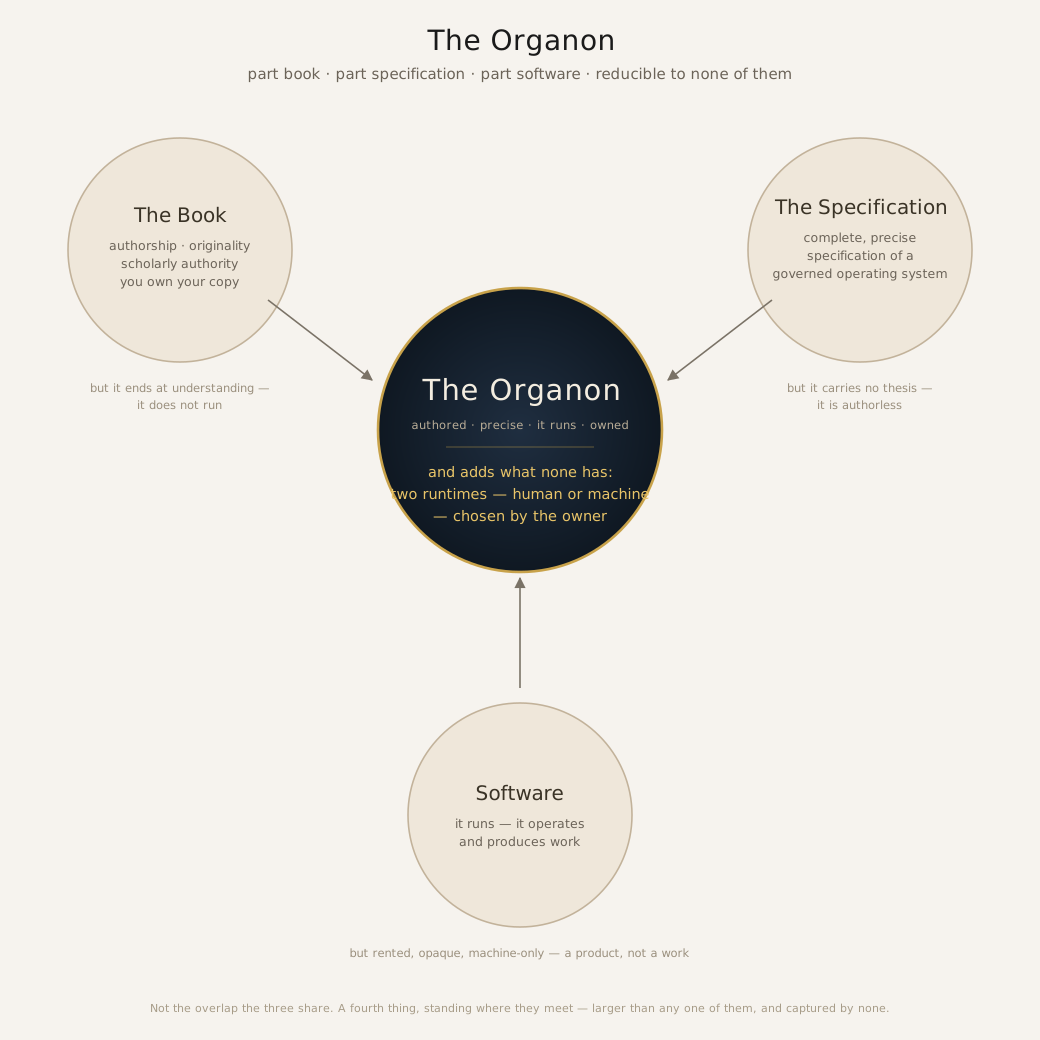
IV. Three neighbors, one gap each

What it takes from each, and exactly where it departs

The book

Shares

Authorship, originality, scholarly length and density. You own your copy — it doesn't expire when a subscription lapses.

Departs

A book is complete the moment it's understood. This isn't. Understanding is where it begins — the precondition for the thing it exists to do, which is run.

The specification

Shares

It fully specifies an operating system — components, procedures, boundaries, failure modes, recovery. Not just the happy path.

Departs

A specification is authorless by design — transparent to its object, no thesis, no voice. This one argues something. It reads as a work, not a manual.

Software

Shares

The one property nothing else on this list shares: instantiated, it actually runs — produces work, maintains state, pursues an end.

Departs

You own it, not rent it. It's judged as a work, not a product. And the machine doesn't have to be the executor — a person can run it by hand from the page.


V. How it runs

One work, two runtimes, and the choice is always yours

A book has no runtime. A specification has no runtime. Software has exactly one — the machine, as executor. This is instantiated the same way either time; what changes is what the machine does after it boots.

Analog

The default mode. The work is loaded whole into a capable AI, which becomes your guide — locating where you are, issuing the single next move. You execute, with your own hands, faster and with fewer wrong turns than you'd manage unaided.

Agentic

The machine's role extends from guide to executor. You direct, and hold final authority at the points the work's own governance says a human judgment can't be delegated.

Most owners, in time, run the blend — delegating what has earned autonomy, keeping the consequential moves in their own hands. The same work, the same governance, a line that moves only because you moved it.


VI. The frontier, plainly

Why the form is a folder of markdown — and why that isn't a shortcut

Say what this actually arrives as: a folder of plain text files, almost entirely Markdown, plus a small amount of structured indexing. To most people, a folder of markdown means notes — documentation sitting beside a system, occasionally pasted into a prompt for context. That is not what this is, and the distance between the two is the whole matter.

There is a conversation forming right now, among the more careful people building with AI, about the layer outside the model and the harness — the observation that as models and agent-loops both commoditize, the thing that stays differentiated, the thing that actually encodes what a given system is, lives in neither of them. It lives in the structured text around them. A few have started saying this out loud. They're right, and it's good they're saying it. But the conversation has mostly reached the existence of this layer, not what it becomes when someone builds inside it as though it were the system rather than notes about the system.

It instantiates

A defined bootloader brings the system up from cold — governing documents loaded in order, inviolable constraints established before any work begins. A pile of instructions is a heap. A sequence that boots a system in a controlled order is an architecture.

It knows itself

A registry indexes what exists and how the parts relate, so the system can locate its own components instead of the coherence leaking away one file at a time as it grows.

It remembers at two timescales

Short-term state — exactly where the work was left — and long-term memory — what persists across every session — held separately, because conflating them is how a system's memory either ossifies or drifts.

It has a skeleton

A structural distinction between what's immutable (bone) and what may adapt (tissue around it) — so that under the pressure of a long task, the system has something it knows it cannot reinterpret, precisely when pressure would otherwise dissolve its priorities.

It disciplines the model's reasoning

The method is specified so completely that the model is left only a short, inspectable gap to cross by inference — applying an established approach to a specific case, not inventing the approach.

Put those together and the word "folder" has stopped describing it. Under real sustained pressure — density, fiduciary rigor, parts locked tightly enough to be trusted, and the plain demand that the thing actually deploy — a structured-text system built this way has nowhere else to resolve: each component acquires a membrane, a defined edge across which only specified things pass. Density forces the parts to become self-maintaining rather than merely read. A skeleton keeps the standard from eroding under the pressure that erodes standards. And a manifold — the ordering and routing that fires the parts in sequence — is what turns a collection of well-formed components into one running thing instead of simultaneous noise.

Two true descriptions of one form. In the language of biology, it holds together the way a living thing does — bounded, self-maintaining, coherent as a body. In the language of mechanics, it produces power the way an engine does — ordered parts firing through a manifold. Both are accurate, because the form genuinely has both properties: it maintains its own coherence and it does coordinated work.

A precise word for this form, as an engineering object, is a ThECA — a Thesis-Driven Executable Cognitive Architecture (the term borrows from cell biology, where a theca is the protective sheath around volatile, active material — here, the governed casing around volatile AI capability). It comes in two sizes: an organ, answerable for one coherent capability; and an organism, which federates whole organs under a single governing thesis. An Organon is the published form of one — an organ or an organism, authored and shipped for an owner to run.

The folder is not where you configure the system. The folder is the system.

What such a system is worth is a separate question from what it is, and that distinction is kept on purpose — a claim that blurs them isn't trustworthy even when it turns out to be right. The claims this form was built to satisfy have resolved as the engineering predicted they would. That is no longer a promise being made. It is a result being reported.


VII. What you actually hold

Owned, not rented — because the ownership is part of the definition

The dominant arrangement for capability today is rental: access granted for a recurring fee, revoked when it stops, governed by terms you don't write and can't inspect. This runs the opposite way. You acquire it once and possess it — in your own files, on a runtime of your choosing, legible to you in full, not contingent on a relationship you don't govern.

And legible in full is meant literally, because it's what makes the ownership real. An Organon is plain files you can open and read end to end — nothing compiled away, nothing hidden behind a service, no black box you're asked to trust. You can read the whole of it before you ever run it, the way you'd read a book before handing it to someone you care about. Owning a thing means being able to see all of it; a capability you can't inspect is just a longer lease. That's why the form is the form.

A firm that authors works to this standard and publishes them for owners to keep is, accurately, a publisher — not a software marketplace, not an app store. The catalogue is a catalogue of works. The books and the Organons in it are siblings on the same shelf: different in kind, alike in being owned outright by whoever acquires them.

Read the full argument

This page is the short account. The essays are the long one.

Two companion pieces on the Substack go deeper than this page has room for — one on why the structured-text layer is where a system's real intelligence lives, one on what that layer becomes under sustained pressure to be dense, trustworthy, and deployable all at once.

ORGANISMIC is a publishing house for capabilities you can read, run, and own. Every Organon in the catalogue is built the way this page describes — not as a metaphor, but as the actual architecture.